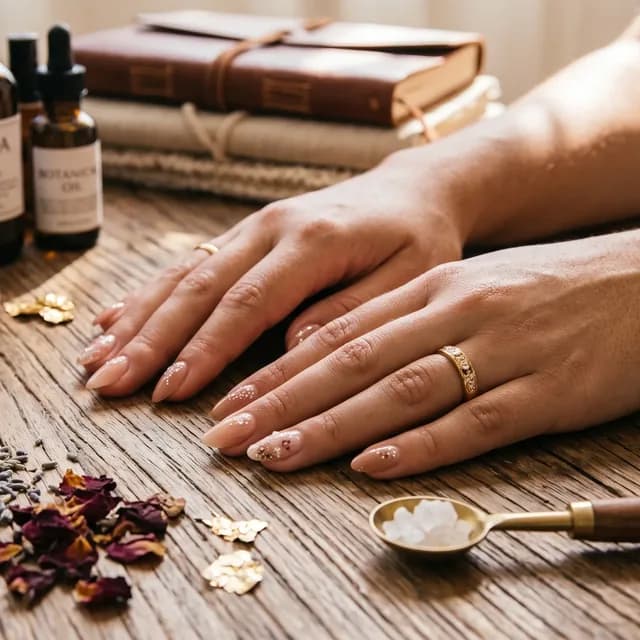
Immediately after removal
| Do | Do not |
|---|---|
| Apply cuticle oil generously | Buff to "smooth out" the ridges |
| Hand cream | Apply another set immediately if nails feel sore |
| Trim short | Keep length that will catch and tear |
| File gently to smooth the edges | Use nails as tools while they are fragile |
Do not buff away the white patchy texture. That is thinned nail plate, and buffing removes more of what is left. It looks better for a day and is worse for a month.
The daily routine
| Frequency | Action |
|---|---|
| Twice daily | Cuticle oil, massaged in properly |
| After every hand wash | Hand cream |
| Every wet task | Gloves |
| Weekly | Trim or file to keep them short |
Cuticle oil is the highest-return habit here by a wide margin. Flexible nails split less, and splitting is what costs you length. It is also the cheapest item on the list.
Do you actually need a break?
| Situation | Recommendation |
|---|---|
| Nails feel thin but not sore | A break helps but is not essential |
| Nails sore or sensitive | Take a break |
| Visible white patches | Break recommended |
| Nails lifting or separating from the bed | See a doctor |
| Nails feel completely normal | No break needed |
On "letting nails breathe"
The nail plate is dead tissue and does not respire. "Letting nails breathe" is not a physiological process — the nail bed underneath gets everything it needs from blood supply, not from air.
The useful idea buried in the phrase is real, though. A break helps because you stop filing, buffing and soaking, not because nails need air. If you frame it that way, it also tells you what a useful break looks like: no enhancements, minimal buffing, and gentle removal of anything you do wear.
Can you wear polish while recovering?
Yes, and it can genuinely help — a layer of regular polish protects a fragile free edge and stops layers catching on fabric.
| Do | Note |
|---|---|
| Regular polish | Fine, and protective |
| Non-acetone remover where possible | Gentler on already-dry nails |
| A hydrating base coat | Reasonable |
| Peel-off polish | Avoid — the habit is the problem |
| Another gel or dip set | Only once nails feel normal again |
The honest timeline
| Period | What to expect |
|---|---|
| Weeks 1 - 4 | Thin, may split. This is the frustrating stage |
| Months 2 - 3 | New growth at the base looks normal |
| Months 4 - 6 | Fully grown out |
Nothing shortens this. Fingernails grow at a fairly fixed rate, so the only variable you control is how much of the new growth survives to become length — which is exactly what the routine above is for.
Going back to enhancements
Most people do go back, and there is nothing wrong with that. A few things make the next round easier on your nails.
- Wait until nails no longer feel sore or sensitive.
- Ask for light buffing only during prep, and say why.
- Ask for thinner application if your nails are still thin.
- Never peel a set off, even the one that is already lifting at the edges.
- Have lifting repaired promptly rather than leaving it for the next appointment.
- If a nail is discoloured, thickened or lifting from the bed, see a doctor before applying anything over it.
Frequently asked questions
Q.How long until my nails recover after gel?
Three to six months for a full growth-out. New growth at the base usually looks normal by month two or three.
Q.Do nails need to breathe?
Not physiologically — the nail plate is dead tissue. A break helps by stopping the filing, buffing and soaking cycle.
Q.Should I buff the ridges out?
No. That removes more nail plate from a surface that is already thin.
Q.Can I wear regular polish while recovering?
Yes, and it can protect a fragile free edge. Use a non-acetone remover where possible.
Q.What if they are sore?
Take a break from enhancements, and see a doctor if the soreness persists or a nail is lifting from the bed.
Keep reading
What people read next after this page